
I thought the biology would be the hard part. I was wrong.
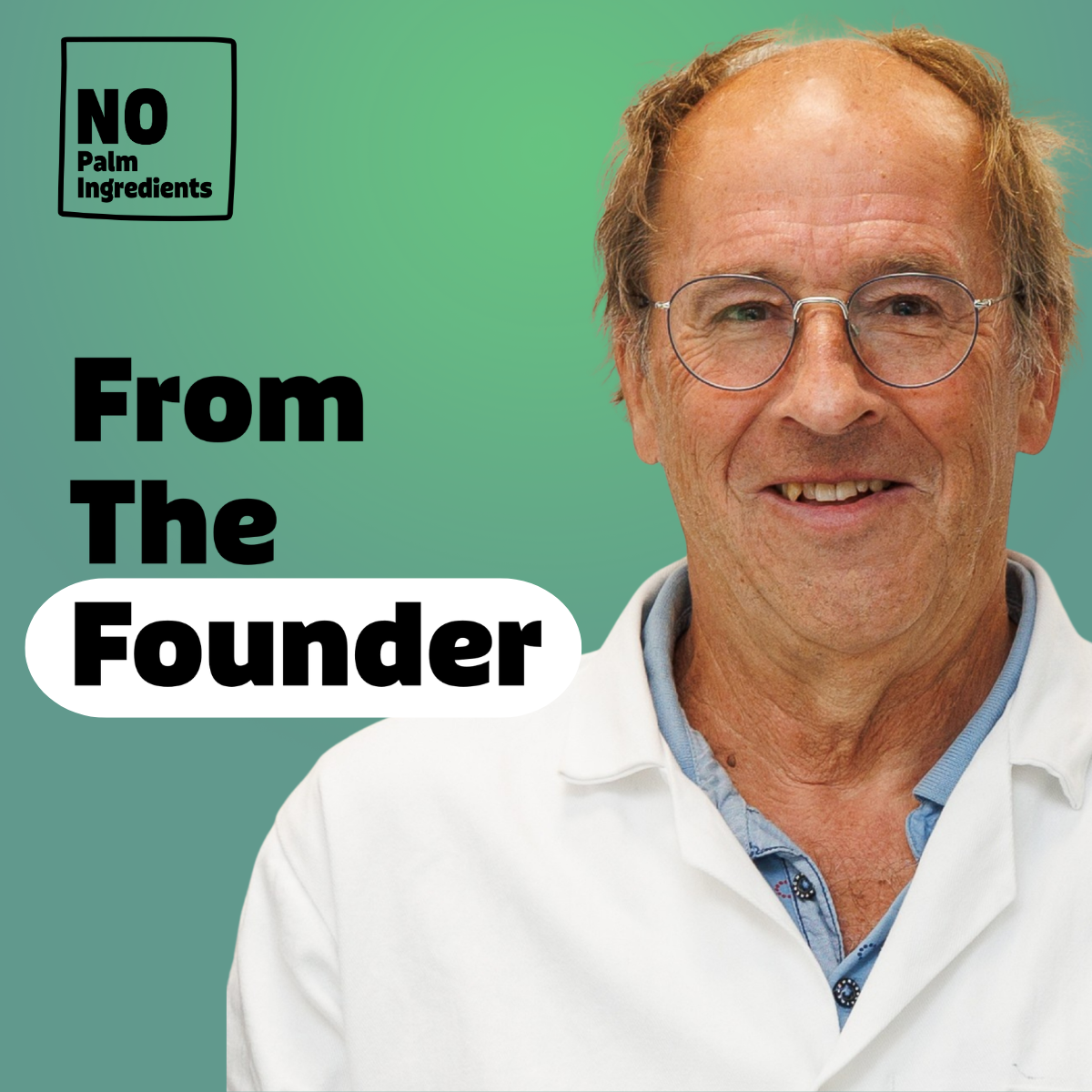
By Prof. Dr. Jeroen Hugenholtz, Co-founder & CTO, NoPalm Ingredients · August 2026 · 6 min read
What scaling a fermentation process from 400 litres to 120,000 litres actually taught me, and why the batch we lost mattered more than the batch we kept.
When we started NoPalm Ingredients, I was convinced that the hardest challenge ahead of us was scientific. Proving the biology at larger scale. Demonstrating that the physics of fermentation would hold as the vessel size grew by orders of magnitude. That is, after all, what my academic training prepared me for. Hypothesis, experiment, result. Repeat until proven.
I was wrong. Not about the science being hard. It is hard. But the biggest challenge turned out to be something my scientific career had barely prepared me for at all: getting the operations up and running, when at industrial scale nothing existed that could simply be replicated from the lab.
This is the story of our first large-scale production runs. A 120,000-litre campaign across four countries, four partners, and one very cold lesson about what it really means to scale deep-tech from the inside.
Why we had to go outside
In 2024, NoPalm needed to demonstrate something critical: that what worked at 400 litres in our pilot line would also work at genuinely industrial scale. Not for our own satisfaction, we believed in the science. But for everyone else: for investors building a TEA model, for customers who needed pre-industrial volumes to run their own trials, for partners evaluating co-location agreements that would define the trajectory of the company.
The problem was straightforward and brutal in equal measure. We did not have our own large-scale fermentation capacity. Nobody was going to build it for us before we had proven we needed it. And we urgently needed to prove we needed it.
The solution was to go out. To find partners at each step of the process who could run their piece of it at the scale we needed, and to connect those pieces into a single production run that, if it worked, would prove everything we needed to prove.
What followed was one of the most complex logistical and scientific operations NoPalm has ever attempted. Four steps. Four partners. Four countries.
“We were not just scaling a technology. We were simultaneously designing a supply chain that had never existed before, for a process that no single partner could run end to end”
Four countries, one process
The feedstock, whey permeate, a side stream from dairy production, came from Belgium, where we had established a supply relationship with a dairy industry partner. This was not just a practical choice. Upcycling an industrial side stream is central to what NoPalm Ingredients stands for: producing REVÓLEO™ without creating new demand for virgin agricultural resources.
The fermentation itself ran in Germany, at a partner facility with the vessel size we needed. This is the heart of the process, where billions of oleaginous yeast cells convert sugars into fat, accumulating lipid inside their cells until the moment we decide to harvest. Getting this right at 120,000 litres, in a facility built for a different process, with a team that had never run our specific organism before, required weeks of preparation and close collaboration between our team and theirs.
From Germany, the fermentation broth moved to the United Kingdom for the downstream process. And then to France for refining: the final steps that turn a crude yeast oil into REVÓLEO™, with the fatty acid profile and functional properties our customers need.
On paper, it was a remarkable achievement. Four specialised partners, each world-class in their step of the process, connected into a single production campaign. In practice, it was extraordinarily difficult to coordinate, and extraordinarily prone to failure at every handoff.
The phone call
The fermentation in Germany was a success. Our team knew it in real time, the biological conversion had gone exactly as it should, the yeast had performed, the numbers were right. There was genuine celebration. Four years of science, proven at a scale that mattered.
Then came the phone call.
One of our fermentation scientists called to tell me that the batch had been lost. During transport from Germany to the United Kingdom, the temperature of the fermentation broth had not been maintained. By the time it arrived, contamination had set in. The entire batch had to be discarded.
I remember the weight of that moment. Not panic, there was no time for panic. But a very specific kind of disappointment that comes from having worked intensely toward something, having succeeded at the hardest part, and then losing it to something entirely outside your control. A logistics failure. A temperature on a truck.
“We had just proven the science worked at industrial scale. And then we lost the batch in a vehicle somewhere between Germany and the United Kingdom. That is the reality of building something genuinely new.”
The decision to re-run was immediate. Not because we were certain it would work, but because we had no other option. The multi-country approach was the only path available to us. We could not build our own 120,000-litre fermenter. We could not compress four steps into one location. The process required what it required.
What we could change was the transport. For the second run, we better specified refrigerated logistics with continuous temperature logging, a record that travelled with the broth from Germany to the United Kingdom and could be checked at every stage. Our team added intermediate checks between partners. Nothing would move to the next step without verification.
The second run was successful. The broth arrived in the United Kingdom within specification. The downstream processing worked. The refining in France produced the REVÓLEO™ we needed. We had our proof.
What the team made possible
I want to be honest about something that the scientific publications and the investor presentations do not always capture: none of this would have happened at the speed it did without the people who joined NoPalm Ingredients team at the very beginning with a very specific kind of expertise.
Anton Happel, Jurgen Snelders, and Jeroen Blansjaar came to NoPalm Ingredients with deep, hard-won experience in industrial fermentation and process engineering, the kind of knowledge that only comes from having run large-scale operations and made exactly the kind of mistakes we were trying to avoid. They understood immediately what the academic literature does not fully prepare you for: that scaling is not a scientific problem with a scientific solution. It is an operational problem that requires operational expertise.
When I think about how quickly NoPalm Ingredients moved from a laboratory process to a 120,000-litre production run, the honest answer is: because of them. The biology I could lead. The operations required people who had built and run industrial processes before, and who were willing to apply that experience to something that had never been done in exactly this way.
What I learned about building
The batch we lost taught me more than the batch we kept. Not only about fermentation chemistry or downstream processing. It also taught me something about what it actually means to bring science to industrial reality.
In a laboratory, you control the variables. Temperature, pressure, timing, contamination risk: all of it is within your reach. The experiment behaves the way you designed it to behave. When it fails, it fails in a way you can interrogate and learn from.
At industrial scale, across four countries, with four different partners and four different operational cultures, you do not control the variables. You manage risks you cannot fully see, across a supply chain that did not exist before you needed it. The science is the same. The world around the science is entirely different.
The moment you decide to re-run after losing everything is the moment you find out whether you are actually building a company or just running an experiment. For NoPalm Ingredients, that decision took about thirty seconds. There was no real alternative, but more than that, there was no real doubt. We had proven the science. We would prove it again.
We are now preparing our FOAK factory: a dedicated production facility co-located with our dairy industry partner in Langemark, Belgium, that will bring the fermentation, downstream processing, and much of the supply chain under one roof. The four-country production run will not need to be repeated. What it taught us, about operations, about logistics, about building a team with the right combination of scientific depth and industrial experience, will travel with us into everything we build next.
There is something we are working toward this autumn that will give more people the opportunity to be part of what NoPalm Ingredients is building. I will share more about it soon. If you want to follow this story as it develops, the newsletter is the best place to start.
Prof. Dr. Jeroen Hugenholtz
Co-founder & CTO, NoPalm Ingredients Fermentation scientist. Professor. Learning every day what it takes to bring science to industrial reality.