

Boring is the target
Alternative ingredients rarely fail on performance. They fail on how much change they ask a factory to absorb.
Julie Cortal, CCO and co-founder, NoPalm Ingredients
There is a pattern in alternative ingredients that should worry anyone working in the field.
A material performs well in the lab. It has a genuine sustainability case. Customers express enthusiasm, run trials, say encouraging things in meetings. Samples go out. And then nothing happens.
The post mortem usually blames price, or customer conservatism, or timing. It is rarely any of those. It is that the ingredient asked a factory to change, and nobody in that factory had a reason to absorb the change.
The enthusiasm trap
Ingredient companies tend to sell to the people who are paid to be interested in new things. Innovation teams, sustainability leads, R&D managers. Those people can be genuinely committed and still be unable to make adoption happen.
The people who decide are elsewhere. Operations. Quality. The plant manager responsible for a line running a product with enormous volume behind it, who carries the consequence if something goes wrong at three in the morning.
For them a new ingredient is not an opportunity. It is a list of risks. A process window that may move. Specifications to rewrite. Trials to schedule. Downtime to justify. A supplier with no track record. A sensory difference the consumer might notice.
None of those risks are offset by your sustainability story, because that story is not what they are measured on.
I learned this as a product innovation manager at Mars, working on M&M's across Europe. What looks like a small formulation change from a development office is never small by the time it reaches a line. The distance between those two views is where most good ingredients die.
Adoption cost
It is worth naming the thing properly, because the industry talks about price constantly and about this almost never.
Every ingredient carries an adoption cost: the total burden it places on a manufacturer to switch to it, entirely separate from what it costs per tonne.
Reformulation work. Process changes. Ingredients list changes. Capital expenditure. Requalification. Regulatory exposure. Supply risk. Sensory risk with the end consumer. Internal approvals across three functions that do not report to each other.
You can be cheaper per tonne and more expensive to adopt. That happens constantly, and it is why straight price comparisons between an incumbent and a new ingredient are often meaningless.
The implication is uncomfortable for any technology led company. Reducing adoption cost is usually worth more than improving the product.
Which makes parity a commercial objective, not a technical one
This is why we treat functional parity the way we do, and why I distrust the phrase whenever it appears as a blanket claim. Nobody achieves parity in general. It only means something attached to one fat, in one application, against one incumbent.
Our fat does not have the same composition as the fat it replaces, and chasing identical composition would be the wrong objective anyway.
A manufacturer does not need a molecule. It needs a behaviour. Does it melt at the right temperature. Does it deliver the right solid fat content at the right point. Does it crystallise to the right particle size. Does the finished product have the same mouthfeel, the same structure, the same stability on shelf.
So parity, for us, means functional parity in a defined application. Replacing shea butter in margarine. Replacing milk fat in cream cheese. Different composition, same job, in the format the customer already runs.
In the applications we prioritise for a given reference, the target is a 1:1 replacement in the existing formulation. If the recipe has to be redesigned around us, the work is not finished.
The surprise inside our best result
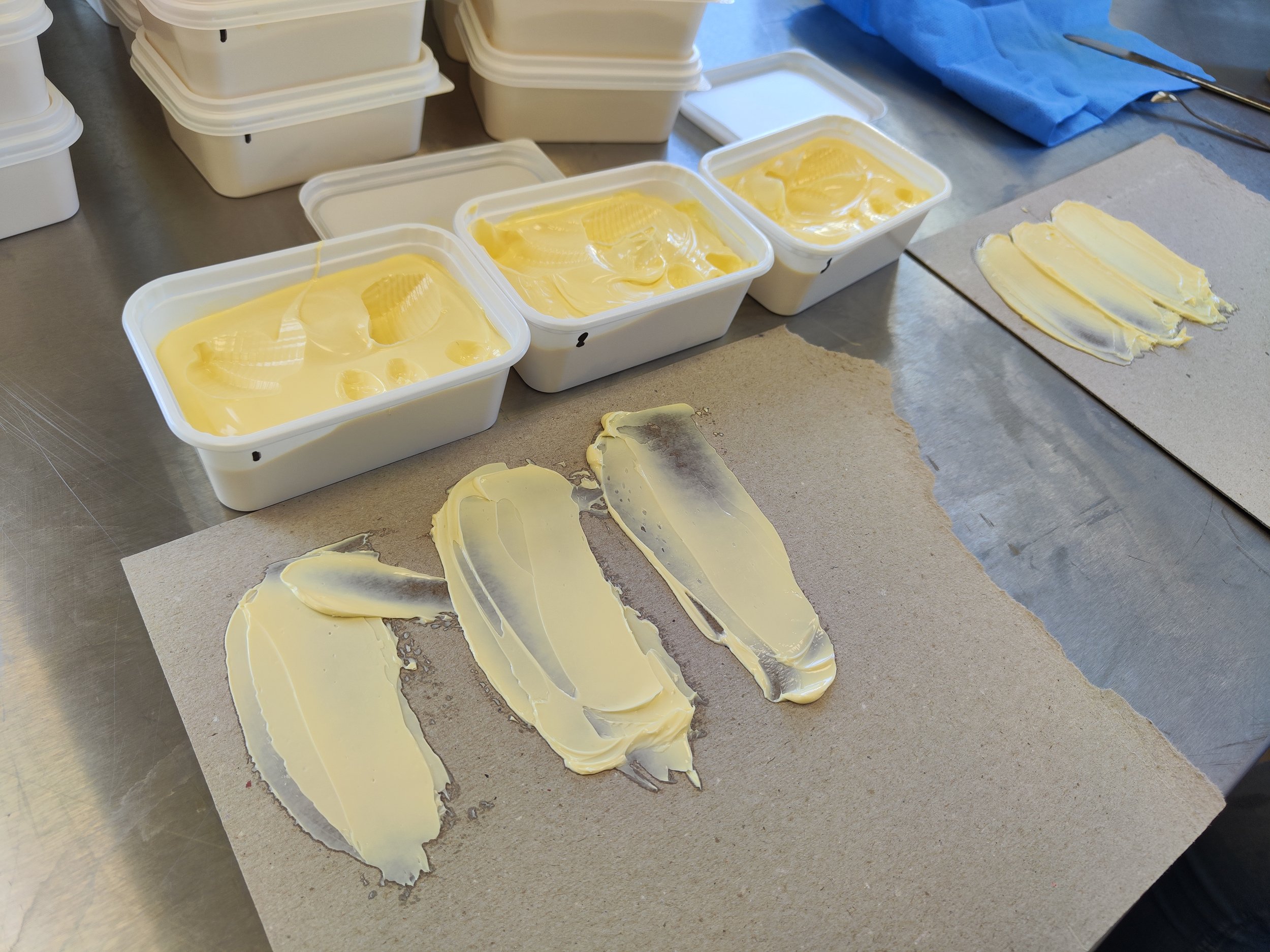
Margarine is our favourite example so far. Side by side against a shea butter control, we cannot see a difference in the samples.
It still surprised us.
At the same solid fat content, ours came out harder. That is the composition difference appearing in the finished product, and it meant the formulation had to be reworked rather than simply swapped.
It happened to move in the favourable direction. More hardness at the same solid fat content suggests we may be able to use less of our fat to reach the same result, which takes cost out rather than adding it. We will take that.
But it was a finding, not a design intention. Not every surprise goes that way, and some of them have cost us months.
Publishing the results that go well and quietly dropping the ones that do not is how an entire category ends up with claims nobody believes. The formulators we sell to have seen enough of that to discount anything that sounds too clean.
Full replacement is not always the answer
There is a second consequence of thinking in adoption cost rather than performance.
Against cocoa butter, our first reference does not deliver the same functionality, and we do not pretend it does. But at a low inclusion in the cocoa mass it still does useful work, and cocoa butter is currently one of the most expensive fats on the market. There, a few percent is the commercially interesting number, not a hundred.
Knowing which applications call for full replacement and which call for a small inclusion is most of the commercial job in this industry. Companies that pursue only full replacement leave the easiest revenue on the table, and they usually do it because full replacement is the more impressive technical story.
The compliment worth aiming for
A large FMCG customer told us that working with our fat was boring.
In a category that rewards novelty, that is the highest compliment an ingredient can receive. Boring means the production line did not care. It means the adoption cost was close to zero. It means nobody had to write a risk assessment about us.
Novelty is what gets you a meeting. Boring is what gets you a purchase order.
NoPalm Ingredients produces REVÓLEO™, a specialty fat made through biomass fermentation of oleaginous yeast on upcycled agrifood side streams.